When it comes to teaching the Humanities, some topics just aren’t as interesting as others. In Psychology class it’s easy to spark student interest in the subject of mental illnesses, for example. The teenage attention span seems to shorten dramatically when it comes to drier topics such as “The Mechanics of Human Language.” What’s a try-hard educator to do? Why, go over the top, of course! In this instance, I chose to emulate a challenge common in professional escape rooms, the translation of a “secret code.”
Type of Game: Escape Room
Cost: Free, but takes some time to put together.
Recommended Age: Probably 7+, as this requires some higher-level thinking
Group Size: Ideally 2 – just enough to share responsibility, but no one slacks.
Time: 10-15 minutes, including setup and execution.
Developed Skills:
- Team Work
- Time Management
- Stress Management
- Application of Content Knowledge
The Game
You can find the link to my version of a “Translate or Die” game above, titled “A New Language.” It’s designed to stand alone but is based on the type of puzzle often found as part of a larger escape room setting. In these situations a group is given a limited time, usually 60 min., to achieve a larger goal by solving a series of puzzles.
Translation puzzles usually require the deciphering of a mysterious code before applying it to a solution. “A New Language” starts by providing key words translated from “Ancient Venusian.” Once students have become comfortable playing around with the fictional language, they are presented with the throne room inscription. Once the first group completes the translation of the throne’s message, things get interesting.
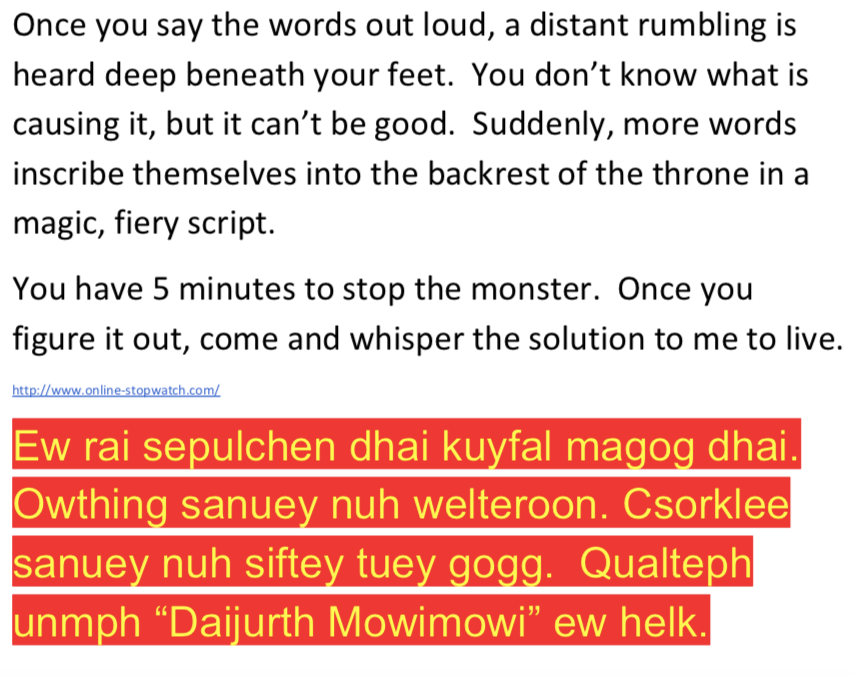
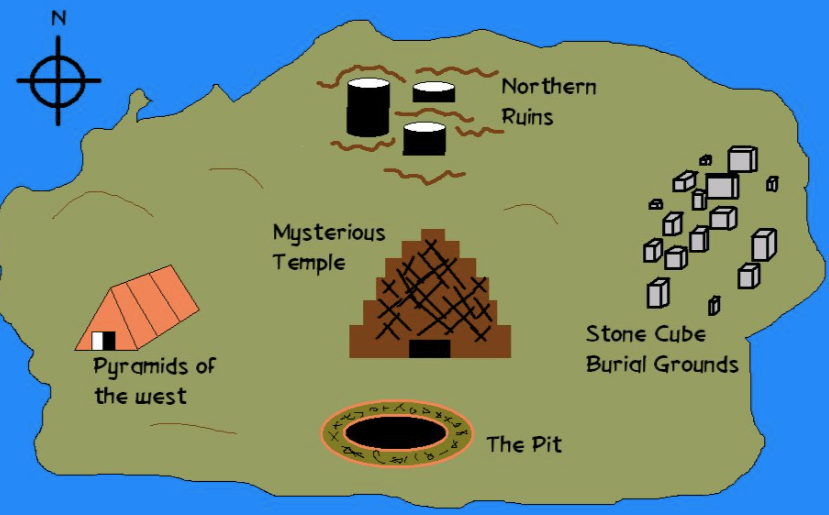
I put on adventurous music and tell them that, just as the translation states, a monster is on the way! A countdown timer, the phrase, and a map of the island are displayed as the game enters its final phase. Usually, 5 minutes is more than enough time for them to complete the challenge but it injects a little fun into the study of language, making the process more exciting for everyone.
Making it Work for Class
I’ve found that keeping an air of mystery will often help maintain interest throughout. Plus, if the students don’t quite know what will happen next, you get to have a little fun yourself as you carry them through the game.
There needs to be preparation and sometimes scaffolding to get students up to the level of the game. If they don’t understand the code that you’re using then no one will have fun through all the frustration.
Some Educational Uses
- In Psychology, my “code” is part of the lesson. Students have to work with phonemes, morphemes, semantics and sometimes syntax.
- In Science class, the “code” can come from the periodic table of elements. A list of code words standing in for different elements can help students solve the “secret compound formulas” hidden in a message. THese compounds can of course be ones that they need to know.
- In English class, the “code” can be old or middle English words translated into their modern equivalents. Figuring out the messages being send forward to them by a time traveler from the past can help students understand the meanings of these words before a brush with Hamlet or Beowulf.
 Adventure School: Gaming in The Classroom
You must be logged in to post a comment.