When my students come into the classroom and the desks are all arranged in a gigantic circle, the response is pretty universally “Ugh. What’s THIS?!” We’ve got them conditioned to dread a change in room structure, because it usually means we’re asking themselves to do something social and uncomfortable. By the time we’re done with the second game of Ultimate Werewolf those same students are often leaning forward eagerly, having completely forgotten their previous anxiety.
Type of Game: Hidden Role, Mystery
Cost: $10-$20 (This is NOT “One Night” Werewolf!)
Recommended Age: Probably 8th Grade and above
Group Size: I’ve run this game with up to 33 high school students at a time
Time: About 30 min. per game
Developed Skills:
- Communication / Effective Argumentation
- Process of Elimination
- Critical Thinking
- Analysis of Evidence
- Deceit (Let’s not emphasize that one)
The Game
A quiet village becomes terrorized when werewolves begin eating citizens at night. It’s up to the poor villagers to put a stop to the deaths by finding the werewolves hidden in their midst… but who is innocent and who is a killer? As the number of players begins to dwindle, it becomes a race against time to root out the werewolves before they outnumber the villagers and win it all.
Ultimate Werewolf is not a new game, but it’s a fantastic version of a classic one. Kids in my area most commonly know the variation of this game known as “Mafia,” which uses mobsters as the villain in place of mythical creatures. “Gobbled up by werewolves” is a more acceptable idea in our educational environment than “killed by criminals,” so I prefer ultimate werewolf’s more fantastical premise.
This is a “hidden role” game that pits students against one another. In the simplest version, they are handed a card that identifies them as either one of the villagers or as a werewolf. No one else is allowed to see their card until their character dies or the game ends.
The process unfolds in two phases, “night” and “day.” Each “night,” everyone puts their head down and the werewolves secretly claim a victim. During the day, the villagers try to discover the werewolves through debate and a majority vote. At the end of each phase, whether eaten or voted out, a person leaves the game. For the humans’ sake, the ones that get voted out better be werewolves! While the wolves do have an uphill climb due to their low numbers, I’ve run games where 4 werewolves were able to outwit 27 villagers!
Werewolf is an excellent game for finding out how your students think; unless someone messes up and makes a lot of noise as a werewolf, most villagers are working with zero evidence. The game becomes an exploration of how to get people to vote your way by whatever means necessary.
Making it work for class
In a casual group setting tension naturally builds and people can take their time crafting different arguments to get their way. In the classroom setting, however, time is a factor. Including introduction to the game, I’m usually able to run two sessions with a thirty person class in 50 minutes.
One of the most common time-related hiccups in the game comes when a group must make a decision. Teenagers can be a tad rebellious by nature, and sometimes one group or another won’t see eye-to-eye enough to agree on a player to eat/eliminate. Putting time limits on each phase puts pressure on players to make a decision and often leads to wilder accusations. As the game master, we can make it clear that the game will move to the next phase without anyone getting removed from the game. That’s usually enough to move things along.
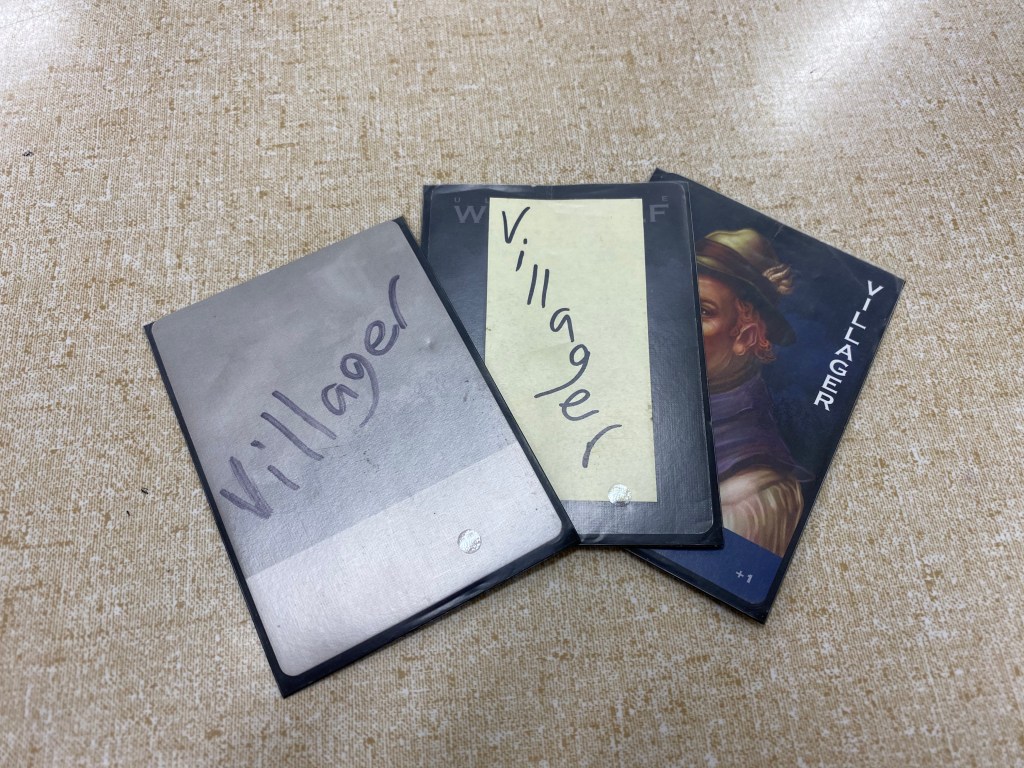
One final and necessary bit of prep work that comes with buying one copy of werewolf is that there aren’t enough copies of the villager card to accommodate a full class of students. This is fine if we dive into a game with special cards straight away, but to play the simp;est version of the game will require some opaque card sleeves and a little modification.
Why it’s Fun
I recommend playing this game in class for the sheer fun of changing things up. Werewolf is just enough intrigue and just enough “danger” to shake kids out of a bland day and get them involved. This is before we even add in the many special cards that add twists to the game! Two fan favorite secret roles that I always add into the second game:
- The Seer – A villager who wakes up each night and gains a little secret information about who might be a werewolf
- The Hunter – A villager who, upon being killed, can immediately eliminate a random player of their choosing! Totally unfair? Yes! Hilarious? Also Yes!
Some Educational Uses
- In psychology, I use this game to highlight how different personality styles (such as “type A” vs. “type B” and the various elements of the “Big 5” approach the game differently.
- In a history class, this game can be used to illustrate the hysteria of the Salem Witch Trials or McCarthyism. The lack of evidence inherent to the game coupled with the tendency of players to throw out wild accusations will usually create an effective parallel.
- In statistics, this is a live demonstration of probability (4 werewolves out of 30, now 4 out of 29, now 3 out of 28…), and can be used as a simple introduction before working with more advanced concepts.
- In english class, this can be used to personally connect a class to the “man vs. man” conflict or to let them exercise logos, ethos, and pathos in their attempts to sway each other.
 Adventure School: Gaming in The Classroom
You must be logged in to post a comment.